Generative engine optimization trend
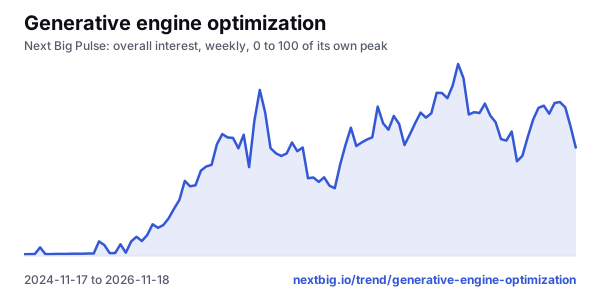
Generative engine optimization is still climbing: overall interest is up steadily. Next Big's projection: likely to level off over the next 12 months.
- Data qualityHow well its sources carry the Pulse's line over the last 13 weeks. Medium data quality: sources from more than one company carry the line lately, not all of them steady. Every label
- Medium
- StageExploding: interest at least doubled over about two years and still sits at 70% or more of its peak. Every label
- Exploding
Two things to know
- Generative engine optimization is exploding on the Next Big Pulse.
- Near its peak: at 87% of its two-year peak; searches at this point were higher a year later 76% of the time, against 73% for any search.
What is generative engine optimization?
Generative engine optimization (GEO) refers to the practice of shaping web content so that AI answer engines such as ChatGPT, Gemini, Claude, Perplexity and Google's AI Mode cite or recommend it. People search it to learn how these systems choose sources and how a brand can appear in their answers. In practice, marketers and SEO teams restructure pages around direct answers, publish comparisons and original data, and seek mentions on third-party lists. The term spread after a 2023 academic paper and grew with AI search in 2025. Measurement remains immature, and results vary widely between engines.
- Wikipedia Generative engine optimization
Behind the rise
Rising around it: the related search generative engine optimization geo (+190%).
Where the line turned
- 1Turned up Feb 2025. Google web search moved first.
- 2Turned up Jan 2026. Wikipedia views moved first, 15 weeks before the next source.
- 3Turned up Aug 2026. Google web search moved first.
Things that happened around the rise, never a claim of what caused it.
- Searches a month
- Under 10,000
- Estimated, US. Thin data: too few searches for a Google Ads figure, so only a bound shows: under 10,000 a month, from another search engine's count and how that count relates to Google's; a Google Ads figure would make it firm.
- Rise so far
- Near its peak
- At 87% of its 2-year peak, climbing 4 weeks. Searches here were higher a year on 76% of the time (any search 73%)
- Shelf life
- 9 to 63 weeks
- How long past rises like this one lasted: median 23 weeks, from 3,914 rises. History, not a forecast
- Next 12 months
- Levelling off
- Next Big's projection, +7%
- Stage
- Exploding
- growing steadily
- Trend score
- 53/100
- Worth building on, from eight parts: how it's made is below the numbers
- Peaks
- All year
- no seasonal peak
How the trend score is made
| Part | Reading | Weight | Points |
|---|---|---|---|
| Growth over a year | 43/100 | 25% | 10.8 |
| The last weeks | 46/100 | 15% | 6.8 |
| Fits a business (judged in review) | 100/100 | 15% | 15.0 |
| Interest now | 56/100 | 10% | 5.6 |
| Kept rising | 0/100 | 10% | 0.0 |
| What a click is worth | no reading, counted as average | 10% | 4.0 |
| Posts about it | 85/100 | 10% | 8.5 |
| Searches a month | no reading, counted as average | 5% | 2.0 |
| Before adjustments | 100% | 52.7 | |
| Trend score | 53/100 |
How worth building on a search is, not how big it is. Every weight is on the methodology.
What's next for generative engine optimization
- Direction
- Climbing.
- Next 12 months
- Next Big's projection: likely to level off (+7%).
- What it opens
- A GEO monitoring service that tracks how often AI engines recommend a brand against its competitors for buying questions.
The next wave inside it
Searches rising fastest alongside generative engine optimization. Breakout means more than five thousand percent.
- how to bake a cakeBreakout
- top tourist attractions in parisBreakout
- best laptop for workBreakout
- hc andersen fødtBreakout
- cheapest flights to tokyoBreakout
- geo+190%
- generative engine optimization geo+190%
Is generative engine optimization really trending?
Only Hunger is measured for generative engine optimization so far: no source of Heat counts it yet, so there's no verdict.
- Hungerwhat people go looking fornot measured over 3 monthsFrom Google web search, Bing searches, Wikipedia views
- HeatHeat: what the crowd is shown, unasked. Posts about it are being counted; the line shows once there are 4 weeks of them, in about 3 weeks.
Real when people are shown it and go looking for it; Early when the crowd is shown it first; Hype when it's shown and not sought; Quiet demand when searches rise with little talk. How the two sides are read.
How popular is generative engine optimization, and is it still growing?
Generative engine optimization draws under 10,000 searches a month in the US, an estimate. Still growing: overall interest in generative engine optimization has been climbing. The line blends every source we read for it, each listed below with its own figures, and the Next Big Pulse confirms the rise.
Each figure compares overall interest at the end of the window with its start.
Who searches for it, and why
Most people search it to learn about it.
Where it's searched most
Interest in generative engine optimization by US state, against the busiest state.
- Kansas100
- Maryland87
- District of Columbia70
- California65
- Louisiana57
- New York48
- Georgia48
- Washington48
- Utah48
- Massachusetts43
What people ask about generative engine optimization
Questions
Best
Compared
Apps and tools
For whom
What's built around it
The apps, code and videos generative engine optimization already has: where the market is, and where it isn't yet.
Reference
Sources
The chart is the Next Big Pulse: every source with a weekly or monthly reading for generative engine optimization, blended into one line of overall interest. A trend counts only when independent sources confirm the rise, each read against what every other search we track did there.
- Google web search44%since Nov 2021
- Wikipedia views30%since Apr 2025
- Bing searches26%since Nov 2024
Data quality: medium, sources from more than one company carry the line lately, not all of them steady. The last 2 weeks rest on fewer sources: they aren't in Bing searches yet. How the grade works
| Source | Rose with it | This search, in a year | The typical search there |
|---|---|---|---|
| Bing searches | Rose | More than for the typical search there. Named, not quoted: its licence. | |
| Wikipedia views | No rise above typical | ||
| Bluesky posts | No rise above typical | ||
| Hacker News mentions | No rise above typical | ||
| Research papers | No rise above typical | ||
| New York Times articles | No rise above typical | ||
| News attention (GDELT) | Rose | More than for the typical search there. Named, not quoted: its licence. | |
+5,000% is Google's Breakout cap, not a measured change.
The same search on Google Trends · How we read every source
Projections are Next Big's forecasts from public search data. They aren't financial, investment, trading or medical advice.
Questions
When do searches for generative engine optimization peak?
It doesn't follow a season. Its busiest week in five years was in June 2026.
Will generative engine optimization keep growing?
Next Big's projection says it's likely to level off over the next 12 months (+7%). It's a forecast from public search data, not advice.
What's rising alongside generative engine optimization?
The searches rising fastest with it are how to bake a cake, top tourist attractions in paris and best laptop for work: often the next wave inside a trend.
More trending in Marketing
All trending nowGet the week's trending searches, first
Monday Trends, every Monday by email: the searches still climbing and what was around each rise. Free; unsubscribe any time.
Or get an invite: Next Big is invite only, and we review every request. Membership starts free: the whole library, and 3 searches watched for you.