Git AI trend
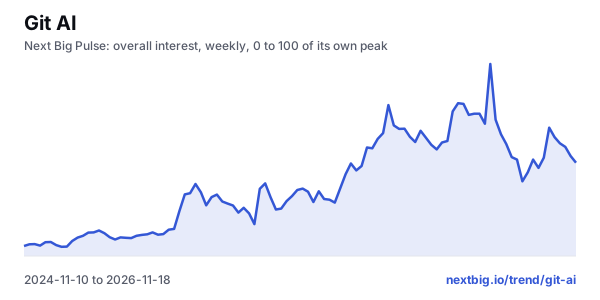
Put its line beside other searches. CompareGit AI is no longer trending: the rise no longer passes the Next Big Pulse's check, so read the chart below as history, not a forecast.
- Data qualityHow well its sources carry the Pulse's line over the last 13 weeks. Medium data quality: sources from more than one company carry the line lately, not all of them steady. Every label
- Medium
- StageExploding: interest at least doubled over about two years and still sits at 70% or more of its peak. Every label
- Exploding
No longer trending as of November 18, 2026. It last passed our check on November 7, 2026. The rise no longer passes the Pulse's check.
Three things to know
- Git AI is exploding on the Next Big Pulse, +38% in a year, about 3K searches a month in the US.
- Mid-rise: at 71% of its two-year peak; searches at this point were higher a year later 69% of the time, against 73% for any search.
- It no longer passes our check (last on November 7, 2026): read the chart as history.
What is git AI?
Git AI refers to an open-source project on GitHub, feder-cr/git-ai, written in Go and described as Git designed for AI agents: version control built for coding agents that make many parallel changes, with topics naming AI agents and coding agents. It gathered thousands of stars within days of its October 2026 release. People search it to read the repository, try it and compare it with plain Git workflows for agents. In practice, the users are developers running coding agents such as Claude Code and Codex. It reflects demand for infrastructure around agentic coding.
Behind the rise
Discussed around it: a YouTube video.
Where the line turned
- 1Turned down Jul 2025. Google web search moved first.
- 2Turned up Sep 2025. Google web search moved first.
- 3Turned down Jul 2026. Google web search moved first.
- 4Behind the rise, Oct 2026: a YouTube video.
Things that happened around the rise, never a claim of what caused it.
- Searches a month
- 3K
- The Pulse now, US, between 2K and 4K
- Rise so far
- Mid-rise
- At 71% of its 2-year peak, climbing 1 weeks. Searches here were higher a year on 69% of the time (any search 73%)
- Overall interest, a year
- +38%
- from 2K to 3K searches a month (rough)
- Last 3 months
- +17%
- no longer trending
- Stage
- Exploding
- growing steadily
- Trend score
- 54/100
- Worth building on, from eight parts: how it's made is below the numbers
- Peaks
- All year
- no seasonal peak
- A click is worth
- $14.90
- what advertisers pay
- Ranking difficulty
- 62/100
- held by big sites
Searches a month added are rough: right direction about 3 times in 4, size within ×2 (check 14a). What that means.
How the trend score is made
| Part | Reading | Weight | Points |
|---|---|---|---|
| Growth over a year | 43/100 | 25% | 10.8 |
| The last weeks | 48/100 | 15% | 7.2 |
| Fits a business (judged in review) | 70/100 | 15% | 10.5 |
| Interest now | 49/100 | 10% | 4.9 |
| Kept rising | 0/100 | 10% | 0.0 |
| What a click is worth | 100/100 | 10% | 10.0 |
| Posts about it | 72/100 | 10% | 7.2 |
| Searches a month | 69/100 | 5% | 3.5 |
| Before adjustments | 100% | 54.1 | |
| Trend score | 54/100 |
How worth building on a search is, not how big it is. Every weight is on the methodology.
What's next for git AI
- Direction
- No longer trending: overall interest stopped rising.
- What it opens
- Tools that write commit messages and review diffs inside the terminal, or tutorials comparing AI features across git clients.
Is git AI really trending?
Only Hunger is measured for git AI so far: no source of Heat counts it yet, so there's no verdict.
- Hungerwhat people go looking forlevel over 3 monthsFrom Google web search, YouTube search, Bing searches
- HeatHeat: what the crowd is shown, unasked. Posts about it are being counted; the line shows once there are 4 weeks of them, in about 1 week.
Real when people are shown it and go looking for it; Early when the crowd is shown it first; Hype when it's shown and not sought; Quiet demand when searches rise with little talk. How the two sides are read.
How popular is git AI, and is it still growing?
Git AI draws about 3K searches a month in the US, on the Next Big Pulse. No longer growing: Git AI last passed our check on November 7, 2026. The rise no longer passes the Next Big Pulse's check, so read the chart as history, not a forecast.
- +17%in 3 months, within its own noise, so flatAug 2026 to this week
- +38%in 1 yearNov 2025 to this week
- +628%in 2 yearsNov 2024 to this week
Each figure compares overall interest at the end of the window with its start.
Who searches for it, and why
Most people search it to learn about it.
Where it's searched most
Interest in git AI by US state, against the busiest state.
- Washington100
- Massachusetts90
- Kansas90
- California87
- District of Columbia87
- Maryland71
- Utah61
- Colorado52
- Oregon52
- Virginia48
What people ask about git AI
What's built around it
The apps, code and videos git AI already has: where the market is, and where it isn't yet.
Brands and companies behind it
Who git AI names, makes it or builds it, from Wikidata, SEC EDGAR and GitHub. Each name says where it comes from.
Sources
The chart is the Next Big Pulse: every source with a weekly or monthly reading for git AI, blended into one line of overall interest. A trend counts only when independent sources confirm the rise, each read against what every other search we track did there.
- Google web search69%since Nov 2021
- Bing searches31%since Sep 2024
- YouTube search0%since Mar 2024
Data quality: medium, sources from more than one company carry the line lately, not all of them steady. The last week rests on fewer sources: it isn't in Bing searches yet. How the grade works
| Source | Rose with it | This search, in a year | The typical search there |
|---|---|---|---|
| Bing searches | No rise above typical | ||
| Wikipedia views | No rise above typical | ||
| Bluesky posts | No rise above typical | ||
| Hacker News mentions | No rise above typical | ||
| Research papers | No rise above typical | ||
| New York Times articles | No rise above typical | ||
Seen in GitHub's new repositories (2026-10-21).
Searches a month is the Pulse's reading now, in Google Ads' scale for the US; cost per click and ranking difficulty are Google Ads keyword estimates.
The same search on Google Trends · How we read every source
Projections are Next Big's forecasts from public search data. They aren't financial, investment, trading or medical advice.
Questions
Is git AI still popular in 2026?
No. Git AI is no longer trending: overall interest stopped rising with its searches.
How many people search for git AI?
About 2,890 searches a month in the US, on the Next Big Pulse. It's searched most, for its size, in Washington.
When do searches for git AI peak?
It doesn't follow a season. Its busiest week in five years was in July 2026.
More trending in Software
All trending nowGet the week's trending searches, first
Monday Trends, every Monday by email: the searches still climbing and what was around each rise. Free; unsubscribe any time.
Or get an invite: Next Big is invite only, and we review every request. Membership starts free: the whole library, and 3 searches watched for you.